10. (2024·南通启秀中学月考)已知关于 $x,y$ 的二元一次方程 $(3a + 2)x - (2a - 3)y - 11 - 10a = 0$,无论 $a$ 取何值,方程都有一个固定的解,则这个固定的解为.
答案:10. $\begin{cases}x = 4,\\y = 1\end{cases}$
解析:
将方程整理为关于$a$的形式:$(3x - 2y - 10)a + (2x + 3y - 11) = 0$。
因为无论$a$取何值,方程都成立,所以$\begin{cases}3x - 2y - 10 = 0 \\ 2x + 3y - 11 = 0\end{cases}$
解方程组:
由$3x - 2y = 10$得$9x - 6y = 30$,
由$2x + 3y = 11$得$4x + 6y = 22$,
两式相加:$13x = 52$,解得$x = 4$,
将$x = 4$代入$2x + 3y = 11$,得$8 + 3y = 11$,解得$y = 1$。
$\begin{cases}x = 4 \\ y = 1\end{cases}$
因为无论$a$取何值,方程都成立,所以$\begin{cases}3x - 2y - 10 = 0 \\ 2x + 3y - 11 = 0\end{cases}$
解方程组:
由$3x - 2y = 10$得$9x - 6y = 30$,
由$2x + 3y = 11$得$4x + 6y = 22$,
两式相加:$13x = 52$,解得$x = 4$,
将$x = 4$代入$2x + 3y = 11$,得$8 + 3y = 11$,解得$y = 1$。
$\begin{cases}x = 4 \\ y = 1\end{cases}$
11. (20 分)解下列方程组:
(1) $\begin{cases}x + 2y = 9,\\y = 3x + 1;\end{cases}$
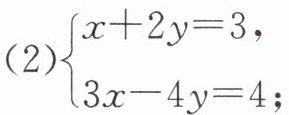
(2) $\begin{cases}x + 2y = 3,\\3x - 4y = 4;\end{cases}$
(3) $\begin{cases}3x - 5y = 3,\frac{x}{2} - \frac{y}{3} = 1;\end{cases}$
(4) $\begin{cases}x + y + z = 6,\\x + z = 4,\\x = 3.\end{cases}$
(1) $\begin{cases}x + 2y = 9,\\y = 3x + 1;\end{cases}$
(2) $\begin{cases}x + 2y = 3,\\3x - 4y = 4;\end{cases}$
(3) $\begin{cases}3x - 5y = 3,\frac{x}{2} - \frac{y}{3} = 1;\end{cases}$
(4) $\begin{cases}x + y + z = 6,\\x + z = 4,\\x = 3.\end{cases}$
答案:11. 解:(1) $\begin{cases}x + 2y = 9,①\\y = 3x + 1,②\end{cases}$
将②代入①,得$x + 6x + 2 = 9$,解得$x = 1$。
将$x = 1$代入②,得$y = 4$。
所以原方程组的解为$\begin{cases}x = 1,\\y = 4.\end{cases}$
(2) $\begin{cases}x + 2y = 3,①\\3x - 4y = 4,②\end{cases}$
①$× 2+$②,得$5x = 10$,解得$x = 2$。
将$x = 2$代入①,得$2 + 2y = 3$,解得$y = \dfrac{1}{2}$。
所以原方程组的解为$\begin{cases}x = 2,\\y = \dfrac{1}{2}.\end{cases}$
(3) 方程组整理,得$\begin{cases}3x - 5y = 3,①\\3x - 2y = 6,②\end{cases}$
②$-$①,得$3y = 3$,解得$y = 1$。
将$y = 1$代入①,得$3x - 5 = 3$,解得$x = \dfrac{8}{3}$。
所以原方程组的解为$\begin{cases}x = \dfrac{8}{3},\\y = 1.\end{cases}$
(4) $\begin{cases}x + y + z = 6,①\\x + z = 4,②\\x = 3,③\end{cases}$
将③代入①②,得$\begin{cases}3 + y + z = 6,\\3 + z = 4,\end{cases}$解得$\begin{cases}y = 2,\\z = 1,\end{cases}$
所以原方程组的解为$\begin{cases}x = 3,\\y = 2,\\z = 1.\end{cases}$
将②代入①,得$x + 6x + 2 = 9$,解得$x = 1$。
将$x = 1$代入②,得$y = 4$。
所以原方程组的解为$\begin{cases}x = 1,\\y = 4.\end{cases}$
(2) $\begin{cases}x + 2y = 3,①\\3x - 4y = 4,②\end{cases}$
①$× 2+$②,得$5x = 10$,解得$x = 2$。
将$x = 2$代入①,得$2 + 2y = 3$,解得$y = \dfrac{1}{2}$。
所以原方程组的解为$\begin{cases}x = 2,\\y = \dfrac{1}{2}.\end{cases}$
(3) 方程组整理,得$\begin{cases}3x - 5y = 3,①\\3x - 2y = 6,②\end{cases}$
②$-$①,得$3y = 3$,解得$y = 1$。
将$y = 1$代入①,得$3x - 5 = 3$,解得$x = \dfrac{8}{3}$。
所以原方程组的解为$\begin{cases}x = \dfrac{8}{3},\\y = 1.\end{cases}$
(4) $\begin{cases}x + y + z = 6,①\\x + z = 4,②\\x = 3,③\end{cases}$
将③代入①②,得$\begin{cases}3 + y + z = 6,\\3 + z = 4,\end{cases}$解得$\begin{cases}y = 2,\\z = 1,\end{cases}$
所以原方程组的解为$\begin{cases}x = 3,\\y = 2,\\z = 1.\end{cases}$
12. (15 分)(2024·兴化期末)甲、乙二人同时解方程组 $\begin{cases}ax + y = 3,\\2x - by = 1,\end{cases}$ 甲看错了 $a$,解得 $\begin{cases}x = -1,\\y = 3;\end{cases}$ 乙看错了 $b$,解得 $\begin{cases}x = 1,\\y = -1,\end{cases}$ 求代数式 $a^2 + 6ab + 9b^2 - 10$ 的值.
答案:12. 解:由题意,得$\begin{cases}-2 - 3b = 1,\\a - 1 = 3,\end{cases}$解得$\begin{cases}a = 4,\\b = -1.\end{cases}$
所以原式$=(a + 3b)^2 - 10 = [4 + 3×(-1)]^2 - 10 = 1 - 10 = -9$。
所以原式$=(a + 3b)^2 - 10 = [4 + 3×(-1)]^2 - 10 = 1 - 10 = -9$。
13. (15 分)(2025·宿豫区期末)已知关于 $x,y$ 的方程组 $\begin{cases}x + 2y - 6 = 0,\\x - 2y + mx + 5 = 0.\end{cases}$
(1) 请直接写出方程 $x + 2y - 6 = 0$ 的所有正整数解;
(2) 若方程组的解满足 $x + y = 0$,求 $m$ 的值;
(3) 无论 $m$ 取何值,方程 $x - 2y + mx + 5 = 0$ 总有一个固定的解,请直接写出这个解.
(1) 请直接写出方程 $x + 2y - 6 = 0$ 的所有正整数解;
(2) 若方程组的解满足 $x + y = 0$,求 $m$ 的值;
(3) 无论 $m$ 取何值,方程 $x - 2y + mx + 5 = 0$ 总有一个固定的解,请直接写出这个解.
答案:13. 解:(1) 因为$x + 2y - 6 = 0$,所以$y = 3 - \dfrac{1}{2}x$。
又因为$x$,$y$均为正整数,
所以当$x = 2$时,$y = 2$;当$x = 4$时,$y = 1$。
所以方程$x + 2y - 6 = 0$的所有正整数解为$\begin{cases}x = 2,\\y = 2,\end{cases}$$\begin{cases}x = 4,\\y = 1.\end{cases}$
(2) 由题意,得$\begin{cases}x + y = 0,\\x + 2y - 6 = 0,\end{cases}$解得$\begin{cases}x = -6,\\y = 6.\end{cases}$
把$\begin{cases}x = -6,\\y = 6\end{cases}$代入$x - 2y + mx + 5 = 0$,得$-6 - 2× 6 - 6m + 5 = 0$,解得$m = -\dfrac{13}{6}$。
(3) 由$x - 2y + mx + 5 = 0$,得$(m + 1)x = 2y - 5$,而无论$m$取何值,该方程总有一个固定的解,所以有$\begin{cases}x = 0,\\2y - 5 = 0,\end{cases}$解得$\begin{cases}x = 0,\\y = \dfrac{5}{2}.\end{cases}$
又因为$x$,$y$均为正整数,
所以当$x = 2$时,$y = 2$;当$x = 4$时,$y = 1$。
所以方程$x + 2y - 6 = 0$的所有正整数解为$\begin{cases}x = 2,\\y = 2,\end{cases}$$\begin{cases}x = 4,\\y = 1.\end{cases}$
(2) 由题意,得$\begin{cases}x + y = 0,\\x + 2y - 6 = 0,\end{cases}$解得$\begin{cases}x = -6,\\y = 6.\end{cases}$
把$\begin{cases}x = -6,\\y = 6\end{cases}$代入$x - 2y + mx + 5 = 0$,得$-6 - 2× 6 - 6m + 5 = 0$,解得$m = -\dfrac{13}{6}$。
(3) 由$x - 2y + mx + 5 = 0$,得$(m + 1)x = 2y - 5$,而无论$m$取何值,该方程总有一个固定的解,所以有$\begin{cases}x = 0,\\2y - 5 = 0,\end{cases}$解得$\begin{cases}x = 0,\\y = \dfrac{5}{2}.\end{cases}$